There are some people who say that the Anti-Christ is first seen in Daniel 11:21 and he’s seen all the way through to verse 45. Then there are those that insist it is Antiochus Epiphanes from verse 21 all the way through verse 45. I am here to prove once and for all that the truth of the matter is, the understanding of the majority in Christendom in my opinion, that Antiochus Epiphanes is indeed seen in verses 21-33-35, but he is not the Willful King of verses 36-45, nor can he be.
Before we begin this journey, let’s take a look at the Main players of this chapter from verses 21-45, thus we can all be on the same page as per what we are speaking about. The Players: from verse 20.
1.) Antiochus III’s son Seleucus IV became king and had to raise taxes because Rome was forcing him to have to pay for all his fathers wars, he was soon poisoned to death it seems.
2.) Antiochus Epiphanes IV, then became king, he is called a vile person. He became king via a series of maneuvers which included flattering the king of Pergamum to gain his allegiance and by the death of the young heir to the throne.
3.) Onias III, High Priest, (prince of the covenant) was replaced via a conspiracy involving the high priests brother Jason and Antiochus Epiphanes but Jason was eventually also double crossed.
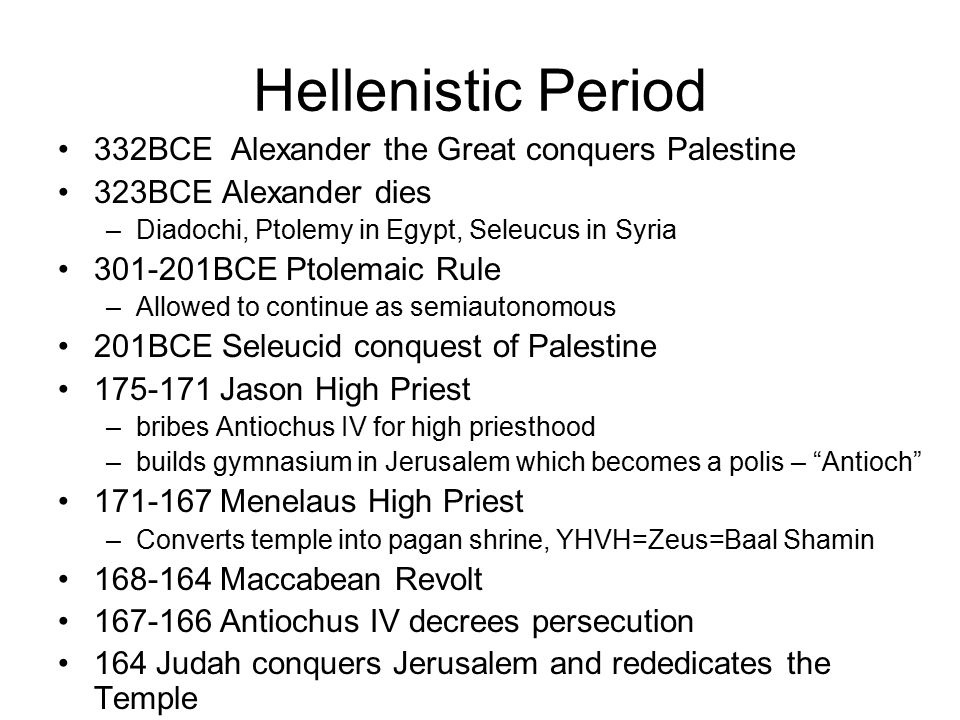
4. Jason (second century B.C.E.), high priest. Jason, who adopted this Greek form of his Hebrew name Joshua, was the son of the high priest Simeon II and a brother of Onias III. According to Josephus he was also the brother of Menelaus, but it is almost certain, in the light of II Maccabees, that this is inaccurate. The events that occurred at the end of the high priesthood of Onias III undermined his standing in the Seleucid court. Jason exploited the ascent of Antiochus IV to the throne (176 B.C.E.) and his need of money to have his brother deposed and to obtain the high priesthood for himself (175), against the promise of large sums of money. Antiochus also granted him authority to establish in Jerusalem a Hellenist polis [ City State ] whose citizens were selected and registered by Jason himself {Registered/Mark of the Beast}. Armed with this authority, he established within Jerusalem a city-state called Antiochia, whose citizens he chose from the Hellenized aristocracy of Jerusalem, and erected a gymnasium { a vile place where people gathered NAKED} in the capital.
His actions led to a strengthening of Hellenistic culture in the city and to a weakening of the traditional way of life and of religious worship (II Macc. 4:7–15). This policy of Jason and his supporters was the chief cause of the Hasmonean revolt which broke out afterward, and which finally freed Judea from the rule of the Seleucids and gave birth to the Hasmonean dynasty. Jason sent envoys and gifts to Tyre in honor of the festivities to the Tyrean god Heracles. He also welcomed Antiochus when he visited Jerusalem in 174 B.C.E. However, three years later he was dismissed from the high priesthood by the king, and Menelaus, who offered Antiochus a larger sum of money for the office, was appointed in his stead. A few years later, in 168 B.C.E., when a false rumor spread that Antiochus was dead, he attempted to return and seize power in Jerusalem. He was unsuccessful, however, and was compelled to leave the city after instituting a slaughter of the inhabitants. For a while he was imprisoned by the Arabian king, Aretas. His last years were spent wandering from place to place, and he was not buried in the family sepulcher.
I think Jason is the Forerunner to the False Prophet, that is why I posted so much information on this man. I want you guys to study this man intently. He betrays his own Jewish brothers, he even betrayed his real brother Onias III, in order to gain the High Priest position. He then tried to Hellenize the Jews or make them like unto the “World” instead of like unto the way God desired the Jews to live via His Laws and Commandments. He then was cast into prison for awhile and was not buried in the Family Sepulcher. Likewise the False Prophet will abandon the Jews serving the real God {Jesus Christ} and stop the Daily offerings to Jesus in my opinion, and then place an Image of the Beast in the Temple of God. He will ultimately be cast into hell with the Beast.
The question is the timing of verses 36-45, does it allow for Antiochus Epiphanes to be the Willful King or must needs he be dead by that time according to the Scriptures ? Let’s delve into this in depth starting in the middle of the Sixth Syrian War where Antiochus leaves Egypt and he travels home/north. This below is the result of his first battle with Egypt before he returns in verse 29.
The guardians of King Ptolemy VI Philometor demanded the return of Coele-Syria in 170 BC, but Antiochus launched a preemptive strike against Egypt, conquering all but Alexandria and capturing King Ptolemy. To avoid alarming Rome, Antiochus allowed Ptolemy VI to continue ruling as a puppet king. Upon Antiochus’ withdrawal, the city of Alexandria chose a new king, one of Ptolemy’s brothers, also named Ptolemy (VIII Euergetes). The Ptolemy brothers agreed to rule Egypt jointly instead of fighting a civil war.
28 Then shall he return into his land with great riches; and his heart shall be against the holy covenant; and he shall do exploits, and return to his own land.
Antiochus Epiphanes returned north it seems because of a rumor that he had died. That rumor seemingly caused a war to breakout in Jerusalem. Antiochus Epiphanes plundered the temple of God, killed many people, then journeyed north to Antioch. (his homeland)
29 At the time appointed he shall return, and come toward the south; but it shall not be as the former, or as the latter. 30 For the ships of Chittim shall come against him: therefore he shall be grieved, and return, and have indignation against the holy covenant: so shall he do; he shall even return, and have intelligence with them that forsake the holy covenant.
In 168 BC, Antiochus led a second attack on Egypt and also sent a fleet to capture Cyprus. Before he reached Alexandria, his path was blocked by a single elderly Roman ambassador named Gaius Popillius Laenas who delivered a message from the Roman Senate directing Antiochus to withdraw his armies from Egypt and Cyprus or consider himself in a state of war with the Roman Republic. Antiochus said he would discuss it with his council, whereupon the Roman envoy drew a line in the sand around Antiochus and said: “Before you leave this circle, give me a reply that I can take back to the Roman Senate.” This implied Rome would declare war if the King stepped out of the circle without committing to leave Egypt immediately. Weighing his options, Antiochus decided to withdraw. Only then did Popillius agree to shake hands with him.
So in 168 BC Antiochus Epiphanes abandoned Egypt for good, so the question is how is Daniel 11:40-45 speaking about this man coming against Egypt again, when History tells us that this man never came against Egypt again, and he died fighting the Parthians, not the King of the South. So he left an commander named Lysyas in charge of the Judean battle and went to the eastern front where he eventually died from a disease. The Maccabean Revolt is mentioned in verses 32-35, and Antiochus dies four years before the Maccabean Revolt is finished. He dies in 164 BC and the Revolt ends in 160 BC. So there is no way he is the Willful King of verse 36-45.
31 And arms shall stand on his part, and they shall pollute the sanctuary of strength, and shall take away the daily sacrifice, and they shall place the abomination that maketh desolate. 32 And such as do wickedly against the covenant shall he corrupt by flatteries: but the people that do know their God shall be strong, and do exploits {Maccabeans}.
33 And they that understand among the people shall instruct many: yet they shall fall by the sword, and by flame, by captivity, and by spoil, many days. 34 Now when they shall fall, they shall be holpen with a little help: but many shall cleave to them with flatteries.
Persecution of Jews
The Seleucids, like the Ptolemies before them, held a mild suzerainty over Judea: they respected Jewish culture and protected Jewish institutions. This policy was drastically reversed by Antiochus IV, resulting in harsh persecutions and a revolt against his rule, the Maccabean Revolt.
Antiochus Epiphanes defiled the temple of God, stopped the daily sacrifices and even built a pagan altar unto Zeus and sacrificed pigs on it. This was an Abomination unto God, but it’s not the Abomination that Jesus and Daniel are speaking about of course. This desecrated the temple while it was there, but as we can see, Antiochus Epiphanes served Zeus, thus he can not be the Willful King of verse 36 as many think, because he served no gods. This of course created a schism so to speak amongst the Jewish peoples, some chose the Hellenistic lifestyle, and some chose to follow God, this is also what will happen in the End Times with the Willful King in my opinion.
Books of Maccabees
According to the authors of the Books of the Maccabees, while Antiochus was busy in Egypt, a rumor spread that he had been killed. In Judea, the deposed High Priest Jason gathered a force of 1000 soldiers and made a surprise attack on the city of Jerusalem. Menelaus, the High Priest appointed by Antiochus, was forced to flee Jerusalem during a riot. King Antiochus returned from Egypt in 168 BC, enraged by his defeat; he attacked Jerusalem and restored Menelaus, then executed many Jews.
When these happenings were reported to the king, he thought that Judea was in revolt. Raging like a wild animal, he set out from Egypt and took Jerusalem by storm. He ordered his soldiers to cut down without mercy those whom they met and to slay those who took refuge in their houses. There was a massacre of young and old, a killing of women and children, a slaughter of virgins and infants. In the space of three days, eighty thousand were lost, forty thousand meeting a violent death, and the same number being sold into slavery.
— 2 Maccabees 5:11–14
Antiochus decided to side with the Hellenized Jews in order to consolidate his empire and to strengthen his hold over the region. He outlawed Jewish religious rites and traditions kept by observant Jews and ordered the worship of Zeus as the supreme god (2 Maccabees 6:1–12). This was anathema to the Jews and they refused, so Antiochus sent an army to enforce his decree. The city of Jerusalem was destroyed because of the resistance, many were slaughtered, and Antiochus established a military Greek citadel called the Acra.
The date of Antiochus’ persecution of the Jews in Jerusalem is variously given as 168 or 167 BC. In their commentary on the Book of Daniel, Newsom and Breed argue for 167, although they state that good arguments can be made for either chronology.
Antiochus’ final years
King Mithridates I of Parthia took advantage of Antiochus’ western problems and attacked from the east, seizing the city of Herat in 167 BC and disrupting the direct trade route to India, effectively splitting the Greek world in two.
Antiochus recognized the potential danger in the east but was unwilling to give up control of Judea. He sent a commander named Lysias to deal with the Maccabees, while the King himself led the main Seleucid army against the Parthians. Antiochus had initial success in his eastern campaign, including the reoccupation of Armenia, but he died suddenly of disease in 164 BC.
So Antiochus dies suddenly in 164 BC, the Maccabean Wars do not end until 160 BC, but the Maccabeans won some battles and even retook the Temple by 164 BC, the book of Maccabeans says him hearing of Lysias defeats caused him to become sickly and die, in their finest prose !!
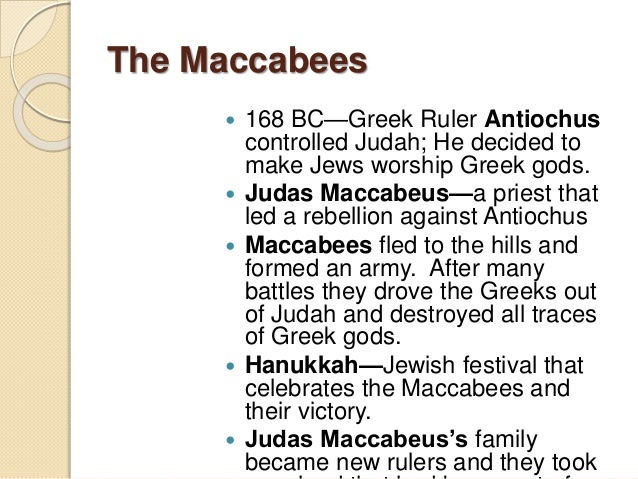
The Maccabean Revolt was a Jewish rebellion, lasting from 167 to 160 BCE, led by the Maccabees against the Seleucid Empire and the Hellenistic influence on Jewish life.
Timeline
In the narrative of I Maccabees, after Antiochus IV issued his decrees forbidding Jewish religious practice, a rural Jewish priest from Modiin, Mattathias the Hasmonean, sparked the revolt against the Seleucid Empire by refusing to worship the Greek gods. Mattathias killed a Hellenistic Jew who had stepped forward to take Mattathias’s place in sacrificing to an idol. Afterwards, he and his five sons fled to the wilderness of Judah. After Mattathias’s death about one year later in 166 BCE, his son Judah Maccabee led an army of Jewish dissidents to victory over the Seleucid dynasty in guerrilla warfare, which at first was directed against Hellenized Jews, of whom there were many. The Maccabees destroyed pagan altars in the villages, circumcised boys and forced Hellenized Jews into outlawry. Judah’s nickname “Maccabbeus,” now used in popular culture to describe the Jewish partisans as a whole, is taken from the Hebrew word for “hammer”.
35 And some of them of understanding shall fall, to try them, and to purge, and to make them white, even to the time of the end: because it is yet for a time appointed.
TRANSITION PERIOD
I think verse 35 is about all the people of God from the time of the end of the Maccabean Revolt/Wars all the way unto the END TIMES, verse 35 says it is an end time that is yet to be appointed/come to pass. I think we all agree that the Maccabean Revolt has started by this time and thus must needs be over by the time verses 36 arrives. We know the Maccabean Revolt started in 167 BC, and that Antiochus was kicked out of Egypt by the Romans in 168 BC, so there is no way that the King of the North in verses 36-45 can be Antiochus Epiphanes VI, it just can not be the case, he is already dead by 164 BC. He never battles Egypt again after the Maccabean Revolt starts, so the Willful King can not be Antiochus, because he Conquers Egypt !!
The Willful King
36 And the king shall do according to his will; and he shall exalt himself, and magnify himself above every god, and shall speak marvellous things against the God of gods, and shall prosper till the indignation be accomplished: for that that is determined shall be done.
The king here has to be the end time Anti-Christ/Beast of Daniel 7:11. He is of course not called the King of the north here in verse 36 for a specific reason, the Sixth Syrian War ended the Syrian Wars. Rome came between Greece and Egypt putting a halt to Antiochus Epiphanes plans of Conquest of Egypt once and for all. If God/Gabriel had called this Little Horn/Anti-Christ the King of the North in verse 36 it might have led some to believe this was still Antiochus !! They do anyway, most should eventually come to see it can’t be him via this thread, but who knows !! So God wanted us to know this End Time King was different from anything before him, he serves NO GOD, whereas we know Antiochus served Zeus. He MAGNIFIES HIMSELF, like the Little Horn of Dan. 7 and 8 does. He prospers until God’s Wrath is finished or until the indignation us done.
37 Neither shall he regard the God of his fathers, nor the desire of women, nor regard any god: for he shall magnify himself above all.
This verse insinuates this man is an Atheist, and that he takes no heed of the thoughts of women, or it may mean he takes no heed unto an observance of the women’s gods, whatsoever that might entail. He listens not to women is the inference I take from this, their desires affect him in no wise. Like modern day Muslims, hes oblivious to their thoughts. He then magnifies himself or elevates himself to the equal of God. He of course demands to be worshiped as God.
38 But in his estate shall he honour the God of forces: and a god whom his fathers knew not shall he honour with gold, and silver, and with precious stones, and pleasant things. 39 Thus shall he do in the most strong holds with a strange god, whom he shall acknowledge and increase with glory: and he shall cause them to rule over many, and shall divide the land for gain.
I think this infers that Satan himself gives him his seat and power, even if he’s not aware of it, but I think he will be aware of it at some point in time. He will be a War monger via the god Forces. Since he is an Assyrian, I think him not knowing the god of his fathers means he will not serve Allah, but will wipe out Islam, and he will be in league with Satan. {Of course}
40 And at the time of the end shall the king of the south push at him: and the king of the north shall come against him like a whirlwind, with chariots, and with horsemen, and with many ships; and he shall enter into the countries, and shall overflow and pass over. 41 He shall enter also into the glorious land, and many countries shall be overthrown: but these shall escape out of his hand, even Edom, and Moab, and the chief of the children of Ammon {Jordan where Israel FLEES.}.
42 He shall stretch forth his hand also upon the countries: and the land of Egypt shall not escape. 43 But he shall have power over the treasures of gold and of silver, and over all the precious things of Egypt: and the Libyans and the Ethiopians shall be at his steps.
Well we know this CAN NOT be Antiochus Epiphanes, he was forbidden from Conquering Egypt by the Romans in 168 BC, he died in 164 BC, during the Maccabean Revolt which were over by this point in time !! We are in the END TIMES here, not in Antiochus’ time. The Maccabeans tore down the Altar to Zeus in 164 BC, so they had defeated the Greeks basically by 164 BC as per running them out of Jerusalem, and the wars were over in total by 160 BC.
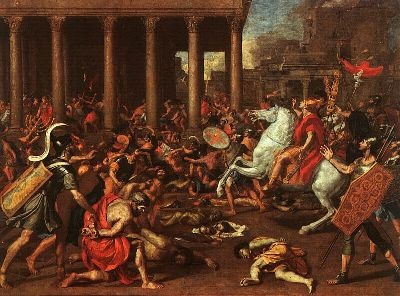
Antiochus Epiphanes IV massacres the holy peoples.





 Prophecy Unvieled